-
Bloodcrete by Sarah Lin (2023)

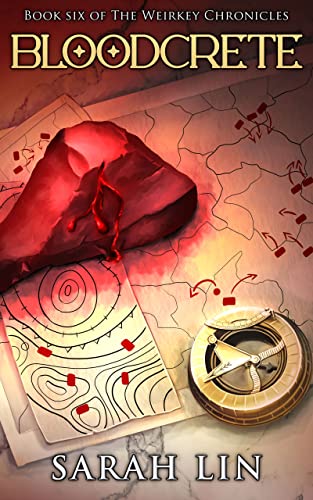
Sarah Lin is one of my favourite Cultivation writers. She always writes interesting magic systems, fun worlds and good characters.
The characters are definitely the draw of this book. The last one, Bondsfungi, ended with the trio breaking up and all going their separate ways. I just assumed that there would be a time skip and this book would begin with them all meeting up. But it doesn’t and it’s all the better for it.
At the beginning of this series the characters were a bit bare boned. Not bad by any means but a bit of a blank slate ready for the details to be filled in. By this point, six books later, they have become very detailed and changed and I love it. It’s really nice to see how they developed as a team and how they continue to develop now that they’ve separated.
As usual the worlds in The Weirkey Chronicles are a highlight. They’re so detailed and so much thought have been put into them. I also love just how different they are, and how different parts in the same world can also be quite different. After the stereotype of ‘a desert planet’ or ‘a swamp planet’ this is a breath of fresh air. Even Tatian, which was lauded in the first book as being bland and samey everywhere you go, is revealed to have a lot of differences in it and those have huge plot implications! It’s fantastic and makes a world I enjoy exploring.
Bloodcrete is a great step forward in both character, details and plot. I read it a couple of weeks ago and I’m only writing this review now because every time I start I end up reading all the books again. Which I think says everything about this series.
-
A Sacrifice of Light by Azalea Ellis (2022)


Following the tradition of the second book, A Sacrifice of Light picks up right after the abrupt ending of the last one. We’re back with the twin identities of Sebastien/Siobhan, both disasters in their own way. It’s worth noting that she’s trying to keep her head down and not draw attention to herself.
So after tangling with an Aberrant and finally realising that she’s Grandmaster Lacer’s apprentice Sebastien’s star is definitely on the rise. Meanwhile people are leaving out offerings and praying to the Raven Queen.
The not drawing attention to herself thing is not going well.
Everything up until this point could be described as a ‘comedy of errors’ and that continues to be the case. But what might get missed under that description is how skilfully the miscommunications can occur. There’s a lot of cases where someone will say or do something that someone else misinterprets but while there’s big and dramatic examples (the Nightmares thinking that the Raven Queen is some sort of shadow and dream spirit being one) there a lot of small ones that might pass by on the first reading. At some point a teacher offers Sebastien an anti-anxiety potion, because of the aforementioned Aberrant encounter, but frames it as because of the dissection. And Sebastien never picks up on the deeper meaning. There’s a lot of these little moments scattered throughout that only become apparent on a second or third reading. It’s incredibly good writing.
The rest of the book is of equal quality. The magic and schemes are engaging, all the mistaken reputations are entertaining and the world continues to expand in a gradual but measured way. I think it’s also worth mentioning that the university classes are fascinating. They don’t necessarily have much to do with the plot, or could be used by Siobhan to improve her magic, but they’re so interesting to read. The history lessons and they way of viewing them and the discussion of spontaneous generation in the first book are my favourite but all of them are worth reading. Considering how often chapters about university classes or lore dumps are worth skipping I am very impressed with how engaging it is.
Finally we actually got a decent ending for the book! It stopped at a logical time, brought all the plot threads to a good place and left some amazing cliff-hangers for the next book. And there’s so much to look forward to! This book has raised a lot of questions about the world and about characters we thought we knew. I’m so looking forward to seeing what’ll happen next.
-
The Gauntlet and the Fist Beneath by Ian Green (2021)


I bought this book because Ian Green is from my hometown of Aberdeen and I like supporting local authors. I wasn’t sure what it would be like though so I wasn’t in any rush to read it and I had plenty of other books to keep me busy anyway.
Turns out I’m an idiot because this might be one of the strongest first books I’ve ever read.
Floré is a sergeant in the Forest Watch, protecting the land and in a sort of retirement after weathering her time in the Stormguard. When mysterious UFOs abduct her daughter she must take up her weapons again and go get her back, no matter what stands in her way.
It has a lot of similarities to David Gemmell’s books and other fantasy from that era. An older warrior, bowed but not broken, being pulled back into the fight. And it’s set in an interesting world, with subtle magic and dead gods, an evil magic storm that blights the land beneath it and other powers hidden from sight. The background lore is well presented and leaves you interested in learning more. And the plot is pretty fun. It leaves you guessing a lot of the time and by the end it’s coloured everything a lovely shade of moral grey.
There’s a good cast of characters, not just Floré and they wander about the story in a great way. Floré is my favourite though. There’s something to be said about a character who will just plough through all opposition with sheer determination, who will keep moving forward despite all injuries, within and without. The fight scenes reflect that, bloody, occasionally brutal but very entertaining.
I very much enjoyed the book and look forward to reading the sequel.
-
Tower Climber 4 by Jakob Tanner (2021)

We’re back, once again, with the most anime of book series. This time Max and Casey must climb higher than ever to a floor that encloses a crime ridden city. It is there, in the midst of a brewing gang war, that they must fight for a mysterious document and siblings will be forced to clash again.
This series is like chocolate for me. It’s not very good for me but I can’t keep away. After the tournament arc Max is left beaten but not broken and filled with a desire to save his sister from herself. And he’s still very much a Main Character. He pulls off incredible last minutes changes of fate and everyone who sees him marvels at how cool and inspiring he is. I honestly don’t know why I don’t hate him but he manages to still be very likeable.
It helps that, more than the others, this books lets side characters shine. And some of them are great. My favourite is the mob boss Jimmy the Frog, who has hilariously stupid powers and somehow manages to pull it off. The different locations are also pretty good. There’s the city, sure, but there’s also a cool junkyard floor which has some nice imagery in the fights there. And finally we get the background of what happened to Max that we’ve all been waiting for.
This book is a lot like the others and the others were fun. It’s a good continuation of the story and it ends on a nice cliff-hanger, opening up for what looks to be an exciting finale.
-
Forging Divinity by Andrew Rowe (2015)


This was not the first Andrew Rowe novel I read. Actually I started with Sufficiently Advanced Magic. But there was some characters in that that came from this series so I thought I’d better read it.
If you’re like me then let me just say, it’s not necessary. There’s a decent amount of background and details that you might miss but ultimately everything important is covered when it becomes relevant in the other series. It’s not a bad trilogy though so feel free to read on.
And if you’ve come here fresh then absolutely read this.
It’s a fun adventure in a D&D kind of spirit. You have characters blundering around, sorting problems while causing a lot of others. The plot is fast and bouncy, leaping from plot point to plot point and a decent rate. There’s sword fights and duels, misunderstandings and magic.
It’s got a neat magic system, not wildly imaginative but done well. There’s Dominions of various types, like earth, fire, knowledge, life, etc, and a sorcerer can reach out and draw upon them. However they also have to give up something in return. For example casting fire magic saps the warmth in your body, using knowledge magic means giving up tiny bits of your memories. It’s nice and balanced and I do like a magic system that has drawbacks as well as advantages.
All in all, it’s a fun book. I just preferred everything that Sufficiently Advanced Magic did. And, to its detriment, it’s the first book in a trilogy that I don’t think ended well. But all in all, it’s pretty harmless.
-
Three Parts Dead by Max Gladstone (2012)

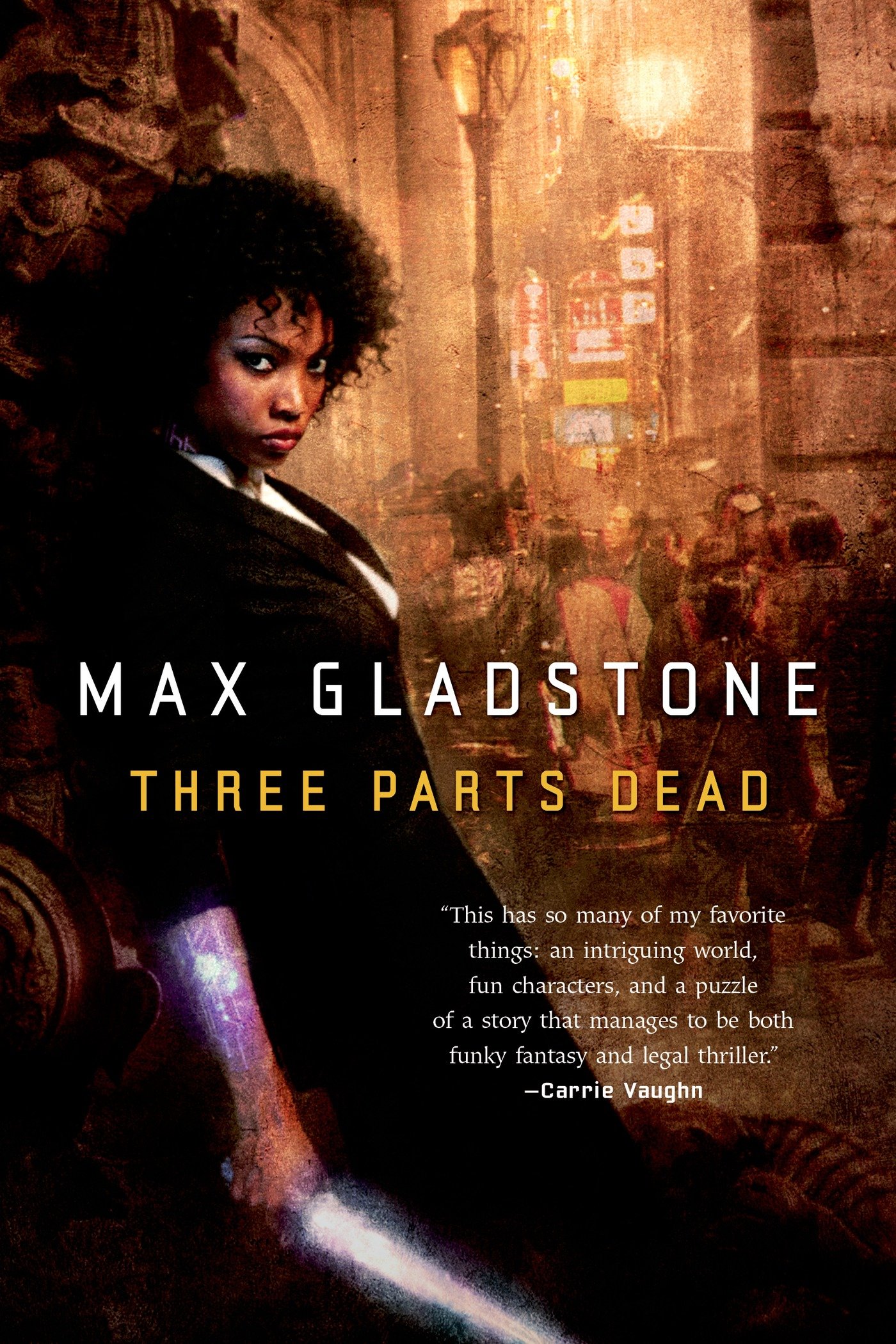
The story begins with a reference to the God Wars, a god getting murdered and a woman being thrown off a floating university to slam into the ground, barely surviving.
Man, does this book know how to get my attention.
And it’s an intriguing world we find ourselves in. Magic has often been seen as about words and contracts and this book brings it to its logical conclusion. Mages are lawyers/accountants, creating contracts of power and selling and buying it to move it between themselves.
It’s an interesting system and lends itself nicely to the plot. The god Kos has died and the auditors are called in to sort out his affairs. I found it easiest to think of Kos as a sentient corporation of power. So all his debts have to be settled, all of the outstanding bargains and divisions need to be sorted and what’s left of him has to be carved up. And yet there’s still the question: How did the god die? And it’s that question that our story revolves around.
It’s got a good cast of characters too. There’s Tara, who is on probation for the necromantic firm she’s just been hired for. Her boss is an old hand at this and covers the bigger picture, leaving much of the grunt work to her assistant. There priests facing a crisis of faith, piratical vampires, drug addled cops and secret contracts. The world is alive, vibrant, a little confusing at times but enthralling all the same.
Also the plotting is just great. The mystery twines nicely around the action, with hints of the eventual reveal. And when all the cards are flipped it leads to an amazing, explosive finale. Seriously, I‘m a sucker for a good ending and this was an amazing ending.
I’ve not read a lot of books like this. It’s new, it’s fresh and it’s powerful. I can’t wait to see what comes next.
-
In the Shadow of Lightning by Brian McClellan (2022)


I loved the first Powder Mage trilogy. It was everything that I wanted to read in a series, with strong characters, an extensive and deep world and a fascinating magic system. In fact it had four magic systems which all sort of did their own thing and had their own place. The Powder Mage aspect, mages who could manipulate gunpowder or increase their own abilities with it, fit perfectly with the Napoleonic Wars era world. It was imaginative and I lapped it up.
I didn’t, however, like the second trilogy as much. Don’t get my wrong, they were still well written but in a lot of ways it also felt like a retread of the first trilogy and an addition to a story that had already ended. I enjoyed it and some of the new characters introduced were fantastic but at the same time I wish it had more. It seemed to lean on the first trilogy a bit too much and some of the characters from that trilogy turning up there felt unnecessary. Also I found the ending a bit unsatisfying.
So going into In the Shadow of Lightning I was a little cautious. But those fear were quickly washed away.
It’s rare that you can actually see an author improve quite so drastically. Brian McClellan’s writing has grown stronger and at the same time a lot more flexible. It looks like he’s taken some inspiration from Django Wexler and I mean that as the highest compliment. In just this first book he’s easily surpassed the Gods of Blood and Powder trilogy. It’s such an improvement that I could see new problems in the Powder Mage trilogy because he’d fixed them here.
Demir Grappo is a fantastic main character. He’s one of those genius generals/plotter characters but he’s broken by events in his past and is only just piecing himself back together. It makes for a flawed person who can do amazing things but is also plagued by self-doubt, which is a very nice balance. He’s joined by a great cast of characters, which brings me back to the problems I saw in the Powder Mage trilogy. That also had a great cast of characters but by the end some of them were feeling a little superfluous. This doesn’t seem like it will be the case for In the Shadow of Lightning. There’s still a lot of moving pieces and I obviously don’t know what will happen but everyone seems to have a solid goal, reason to be there and motivations. I can’t wait to see where they’ll end up.
On some level it does feel a little like a retread of ideas again. The same broad characters types are present here that were in the last two trilogies but the world and the way they’re used are so fresh and different that it doesn’t really matter. A glass based magic system that works really well is exactly what I’d expect from McClellan and it’s used in great ways. The world itself is, as usual, nicely realised and presented. Also there seems to be a lot more LGBT representation in this, which is nice.
I just can’t wait to read more of this. It’s fully restored whatever confidence I might have lost in McClellan as a writer and just made me really excited to see what comes next.
-
Christmas Core by Jonathan Brooks (2021)


Not all books have to be a grand adventure, or a big dramatic showdown. Some are just small looks into an interesting concept. And that’s what Christmas Core is.
Having died while decorating his office for Christmas Elmer Robbins is expecting to head to the Pearly Gates. What he isn’t expecting is to end up in a Dungeon Core, with his wife, Mary, walled off from him in a different, unconscious part of the core. To reach her he must level up and become a dungeon. And so he sets out to do what he knows best. Decorate for the holidays.
The stakes are pretty low. Any adventurer who dies in his dungeon respawns at a nearby temple so there’s no moral quandaries over what happens to them. There’s mild amounts of threat to him but nothing outrageous. It’s mostly an excuse for the Christmas touchstones that we all know to be turned into killing machines.
It’s not very in depth, because it’s not very long at only 152 odd pages. It’s just a quick look at what a seasonal dungeon might look like. It’s not going to set the world ablaze but it’s a nice diversion for a few hours and was fun holiday reading.
However, I will give a quick warning. As much as I liked this book, I think it works best as a standalone and not part of a series. I’ve read the following two books at this point and my experience was that the concept begins to wear a little thin after the end of this one. Feel free to give it a look yourself but I personally would not recommend them.
-
Another Fine Myth by Robert Asprin (2022)
I can very clearly remember when I first read this book. It was in the large print section of the local library and I was enthralled by the weird swamp creature and dragon on the front cover. I borrowed it and devoured it over the course of a week or so and loved every minute of it. I think I was about ten.
Ever since then I’ve been trying to get a copy for myself but it was out of print and copies were quite expensive. So when I saw that they were publishing a new run of it, and illustrated by Phil Foglio, who also does Girl Genius, I knew I had to have it. After all this was an amazing comedic fantasy series, on the level of Terry Pratchett!
Or so I thought. And after having read it again, older and more experienced, I have to admit that it isn’t on that level. It is very good though.
Skeeve is apprenticed to the magician Garkin, though he’s not particularly good at magic. In an attempt to inspire his apprentice and show him what magic can really do Garkin summons a demon from a different plane of existence. However, an assassin kills him before the summoning can be completed (and dies in the process) leaving Skeeve alone with the demon.
Who, it turns out, is a friend of Garkin and was mostly summoned here as a joke. A joke the old magician took too far, because the demon, called Aahz, has had his powers sealed in the summoning and now people are after them. So he need to take over the teaching of Skeeve while tracking down the mysterious figure who is after them.
This is not a long book, it’s got about 212 pages, and the plot doesn’t go super in depth with anything. But it’s fun, the jokes and comedy mostly land and getting through it is pretty light and breezy. While, as I said, not up to Terry Pratchett’s send up of society it does a good job of playing around with common fantasy tropes and working them into new ways. The ending was a little abrupt but there’s apparently a lot more to the series after this and I’m looking forward to reading them.
At the end of the day it is just a fun romp. I can see everything that my younger self loved about it and I’ve not changed so much that I can’t say that I enjoyed it to.
-
Winter’s Orbit by Everina Maxwell (2021)

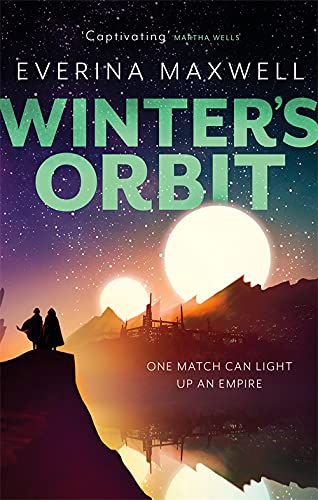
Oh gosh this is just a wonderful book.
Good sci-fi has a way of making you feel small. The universe is a big, big place and even stars are only tiny dots from a distance. We are minuscule and unimportant in comparison. But the best sci fi also makes you feel warm. Yes we are small but our experiences, our lives, our loves and our fears are all important.
The story itself takes place in a solar system wide empire, spanning 8 planets. But, as impressive as that is, it’s quickly stated to be nothing in the grand scheme of things. In fact much of the conflict in the book centres around the renewal of a treaty that would protect them from invasion. If the treaty doesn’t go through, they’ll be quickly gobbled up by larger rivals.
But that is all just the background because Winter’s Orbit is a romance.
It’s the standard set up. Two people are forced together because of means outside their control, in this case a diplomatic wedding, and overtime become closer and find that they are in love. It’s a classic because it works so well. What I particularly like in this case is that this isn’t a ‘these people never seem to have been with anyone else’ kind of relationship. They have, and that’s brought some baggage into their marriage. One of them was married before and the impact of that is felt throughout the book. All in all, it seems very real in a way that romance books often don’t. But still very, very sweet.
All in all, this is just a fantastic book and I heartily recommend it.

